What the World Cup can teach the next Foreign Secretary
Good teams know the rulebook. Winning teams understand the referee. Britain has spent thirty years being the well-behaved side — and the referee has stepped onto the pitch.
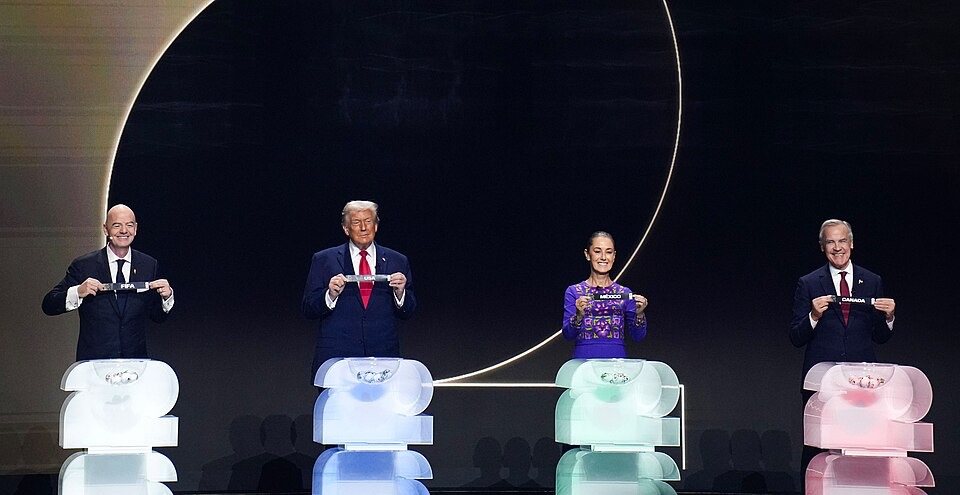
Britain, the EU and Japan hold their line and wait. Russia and China circle the official. The United States, which used to referee this, walks on and stops in the centre circle.
On Monday, Andy Burnham enters Downing Street. Before the boxes can be unpacked, Burnham will have to make one of his most consequential appointments, the next Foreign Secretary. Westminster is already alive with speculation. John Healey, Ed Miliband, Shabana Mahmood and even David Miliband have all been tipped as possible appointments.
Whoever gets the job should do something rather unconventional before reading the latest Foreign Office briefing; They should watch England's World Cup semi-final against Argentina.
That may sound like a strange way to prepare for running Britain's foreign policy but is actually far from it.
Because for one hundred and one minutes, the World Cup offered one of the clearest illustrations of the problem confronting the West today. Not a problem of military capability or economic decline, but of rules, enforcement and the growing gap between the two.
Despite being Welsh (a people with an unusually deep historical relationship with the Argies, and a genetic enmity with England), I can't help but feel a great shame that one of our home teams didn't make it to the final and bring it home. In this sadness, shared with billions no doubt, it is easy to point fingers and scream bias and cheat.
But England did not lose 2–1 because of the referee. Argentina defended superbly, took their chances and maybe they deserved to reach the final.
But by the final whistle, millions of England supporters felt they had watched a game in which the Laws of the Game and the way those laws were enforced had become two very different things.
That feeling ought to be familiar to anyone who has spent the last few years watching international politics.
England's frustration was never really about one yellow card.
Argentina committed twelve fouls to England's seven during a bruising first half. Giuliano Simeone seemed determined to discover precisely how many fouls one player could commit before finding his way into the referee's notebook. Enzo Fernandez was scarcely innocent either. Yet the first booking of the match went to England's Elliot Anderson after a challenge on Lionel Messi.
Live match reporting recorded nineteen fouls between the two sides by half-time, sixteen of them already awarded by the time Elliot Anderson was cautioned for a challenge on Messi — the first booking of the game. Referee: Ismail Elfath, Atlanta, 15 July 2026.
Did Anderson deserve a yellow card? Probably, and most England supporters would concede as much. But that was never the complaint.
The complaint was consistency.
If repeated tactical fouls had been tolerated for forty minutes, why had the threshold suddenly shifted? Why did one side appear able to push and prod the boundaries of the referee's patience while the other was punished at the first opportunity?
Every major decision followed the same pattern. Argentina's players surrounded the referee. Every whistle became an argument. Every decision became something to be negotiated rather than accepted as the English did.
Even the halftime whistle became symbolic. England should have won a corner. Instead of allowing the set-piece to be taken, the referee blew for the interval.
Each incident, taken alone, might have been perfectly defensible. Together, they created something much more corrosive. The perception that one team understood the referee better than the other.
Modern football is a long way from the gentlemanly game we like to imagine once existed. Today's elite game is one of tactical fouls, provocation, surrounding officials and discovering exactly how much can be got away with before punishment arrives.
The teams that succeed are often those that understand not simply the rulebook, but the incentives created by the referee.
Argentina's wider tournament only reinforced that impression.
Supporters christened them "VARgentina". Egypt protested after a controversial disallowed goal and disputed VAR decisions. Debate raged over whether Lionel Messi and co had repeatedly benefited from marginal refereeing calls, despite obvious transgressions. FIFA defended their officials, and stated all the proper rules had been followed.
But that almost misses the point. Institutions do not survive simply because they are impartial. They survive because people believe they are impartial.
Once enough participants begin to suspect that the rules are being applied differently depending on who you are, confidence in the institution itself begins to ebb away.
Then came the Balogun affair. When American striker Folarin Balogun was sent off against Bosnia and Herzegovina, everyone assumed the punishment was automatic. A red card meant a suspension.
Except, apparently, it didn't. Following political lobbying, including intervention from the U.S. President, FIFA suspended the ban and allowed Balogun to play in the knockout stages.
Perhaps the lawyers can explain why the regulations permitted it. That isn't what mattered. What mattered was the message. Rules that appeared fixed suddenly looked negotiable.
Little wonder UEFA is reportedly furious, with senior figures said to be considering backing a challenger to Gianni Infantino. Institutions rarely lose legitimacy because of a single decision. They lose it when enough important players conclude that the referee has become part of the game.
And that brings us to our own foreign policy. For the last three decades Britain has been among the most committed champions of the rules-based international order. There are good reasons for that. We are a trading nation. We benefit enormously from stable institutions, predictable rules and an international system in which disputes are settled peacefully.
But somewhere along the way we appear to have confused respecting the rules with assuming everyone else will. The world has changed.
Russia has shown little regard for international law when it conflicts with its objectives. China continues to ignore rulings it dislikes. Regional powers across the Middle East pursue their interests with remarkable clarity and very little concern for lectures from Geneva or New York.
Even the United States, once the principal guarantor of the liberal international order, increasingly applies international rules when they suit American interests and sets them aside when they do not.
We are far from the delicate and gentlemanly international order imagined at the end of the Cold War. Instead, we inhabit a world of unilateral military action, selective adherence to legal precedent, economic coercion and great powers discovering exactly how much they can get away with before meaningful consequences follow.
Yet too often we continue behaving as though nothing has changed.
Take the Chagos Islands. In this case, government policy is literally based on rulings made by Chinese and Russian Judges; I can't imagine Putin or Xi giving away territory because a British judge insisted they should.
The argument for handing them over really rests on Britain's reputation as a country that respects international law. A noble sentiment, but foreign policy is not an essay in moral philosophy. It exists to defend our security, our prosperity and our national interest.
Retaining sovereignty over the Chagos Islands is important to Britain's long-term strategic position, so why should we voluntarily surrender that advantage when so many other countries treat international law as something to be worked around, or completely ignored.
This is not a rejection of international law. It is an acknowledgement that law has always existed alongside power, not instead of it.
The deeper problem is cultural. We increasingly resemble England in that semi-final. We continue to assume that if we behave impeccably, the system will eventually reward good conduct.
Playing the rulebook
- Accepts the decision and gets on with the game
- Treats the written laws as the whole of the contest
- Assumes good conduct will eventually be rewarded
- Complains afterwards, through the proper channels
- Britain: compliance first, interest second
Playing the referee
- Negotiates every decision at the moment it is made
- Learns where the threshold actually sits, then sits just under it
- Assumes enforcement is a variable, not a constant
- Applies pressure before the whistle, not after
- Russia, China, and increasingly Washington: interest first, compliance where convenient
The two approaches are not a moral ranking. They are a description of which one currently wins.
But what if the system itself has changed?
For decades we could rely upon the United States to act as the referee of the liberal international order. Today it's harder to sustain that confidence, as Washington increasingly pursues its own interests first. Sometimes it enforces the rules, sometimes it bends them, and sometimes it ignores them altogether.
The referee, it seems, has stepped onto the pitch.
We can continue waiting for the referee to intervene, but if the referee is increasingly willing to bend the rules in pursuit of his own interests, who exactly is left to protect those of us still playing by the book?
That is the question sitting in the next Foreign Secretary's in-tray.
None of this means we should abandon international law. Britain has benefited enormously from a stable international order, and we should continue defending it wherever we can. But defending that order should not require becoming its only enthusiastic participant.
There is a profound difference between supporting international law and allowing it to become a substitute for strategic judgement.
Where our legal obligations are genuinely contested, where enforcement is plainly inconsistent, or where compliance would impose serious costs on our economy and security without any realistic expectation of reciprocity from others, we should have the confidence to defend our own interests, even if it upsets Whitehall's international law lobby, led by our soon-to-be erstwhile Prime Minister and Attorney General.
That is not cynicism, but a realistic understanding of statecraft.
Every World Cup teaches a lesson in tactics. This one taught strategy.
Good teams know the rulebook. Winning teams understand the referee.
Our next Foreign Secretary will need to understand both.