The West has a Central Asia problem
For years, Western governments have agreed that Central Asia is strategically important. They have been much less successful at agreeing what they are trying to achieve there.
America's regional strategy expired in 2025. The EU's dates from 2019. Britain has none. The result is a collection of bilateral deals, diplomatic visits and sectoral initiatives, not a serious regional project. China has been more systematic. Its economic footprint is growing, its investment expanding and its digital infrastructure spreading. Now it is building institutions to bring the region into its technological orbit.
What the strategies say
The United States Strategy for Central Asia 2019–2025 sets six objectives, beginning with supporting the sovereignty and independence of the five states individually and as a region. It states the primary American interest as a Central Asia free to pursue its interests with a variety of partners on its own terms, connected to global markets, with strong democratic institutions and rule of law — and adds plainly that close relations with all five will provide a counterbalance to the influence of regional neighbours. It commits the US to supporting a unified regional electricity grid, and records over $34m of funding for C5+1 projects.
US Department of State · 2017-2021.state.gov · text as republished by US Embassy Kazakhstan · kz.usembassy.govSet that against the last year of summits, and it reads well: independence, trade routes, business access, and an admission that the point is to balance against Russia and China. There's just one problem. The strategy ran out in 2025, and a new one is yet to be set out.
The most active Western power has no published regional strategy
That doesn't mean Washington has no policy. It means the policy isn't cohesive or, importantly, comprehendible for business. A government in Astana trying to work out whether an American promise will survive the next election has a summit statement and five country plans, and nothing that says what the US wants across the region or for how long. If your whole approach to the world is "never bet everything on one patron," an unwritten strategy is a reason to hedge, not a reason to stop.
Brussels has the opposite problem: plenty on paper, but little in practice. The EU's 2019 strategy is still in force. A roadmap agreed in Luxembourg in October 2023 broke it into 79 things to do across five areas. And the Samarkand summit in April 2025 upgraded the whole relationship to a "strategic partnership."
The EU's summary to the OSCE stressed sustainable value chains for critical raw materials and the growing involvement of the European Investment Bank and the EBRD in energy, water, connectivity, transport and raw materials projects. Costa's framing was that the relationship had not yet reached its full potential and that the summit would not be a one-off.
Council of the EU joint declaration · consilium.europa.eu · EEAS statement to the OSCE Permanent Council, 10 April 2025 · eeas.europa.euOne academic study of those years says the EU kept its language about democracy and the rule of law but wrapped it inside a bigger story about supply chains, raw materials and making sure sanctions on Russia hold. Values didn't disappear; they got a new job. That's one journal article whose standing I haven't checked, but it fits what the documents now emphasise.
And then Britain, which has no strategy at all.
The Foreign Affairs Committee's December 2023 report was the first Commons inquiry into the region since 1999. It made 28 recommendations, framed the UK's aspiration as being both a reliable long-term partner and a critical friend, and found high-level ministerial engagement to have been "persistently inadequate" and read by partners as a lack of seriousness. Evidence submitted to the inquiry included the assessment that there was little evidence of joined-up thinking or strategy on the UK's part.
House of Commons Foreign Affairs Committee · publications.parliament.uk · Foreign Policy Centre summary · fpc.org.ukThe Government's response accepted the recommendation to convene a CA5+UK meeting in 2024 and said it was exploring the best format. It also listed what was already under way: increased engagement across climate, development, education, trade, security and defence; sanctions-evasion risk training for Central Asian governments and businesses; the Economic Crime and Corporate Transparency Act and a new Combatting Kleptocracy Cell in the National Crime Agency; John Smith Trust fellowships; programmes with Oxford's Saïd Business School; and a Minister for Europe who had visited all five republics.
Government response to the Committee's Tenth Report of Session 2022–23 · publications.parliament.ukThe meeting happened in February 2026, about two years late. And the shape of that reply is the whole point. While MPs asked for a strategy, the Government sent back a list. Every item on the list is fine, but none of it tells you what Britain is trying to achieve, or how anyone would know if it had.
| United States | European Union | United Kingdom | |
|---|---|---|---|
| Standing regional strategy | 2019–2025 — lapsed | 2019 strategy, in force | None published |
| Operationalising document | C5+1; country-level strategies | Joint Roadmap 2023 — 79 action points | A response to a select committee |
| Top-level format | C5+1 leaders' summit, Nov 2025 | Samarkand summit, Apr 2025 | CA5+UK ministerial, Feb 2026 |
| Organising idea | Sovereignty, connectivity, counterbalance, commercial access | Strategic partnership; resilience, raw materials, sanctions compliance | A list of sectors |
What Washington actually did
Paperwork aside, the American offer over the last year has been simple and unsentimental. Recognition and money, in return for minerals, trade routes and the odd headline.
At the C5+1 summit on 6 November 2025, Trump announced that Kazakhstan would join the Abraham Accords — the first Central Asian and first non-MENA state. RFE/RL assessed it as largely symbolic, since Kazakhstan has recognised Israel since 1991, but noted it placed Astana at the centre of a White House effort to revive the framework. Commercial deliverables followed within days: a critical minerals memorandum, $7bn in Boeing airliners, and rail equipment.
RFE/RL via GlobalSecurity · globalsecurity.org · Atlantic Council · atlanticcouncil.org · FDD · fdd.orgSources split on whether this was an announced intention to accede or a completed accession, and I could not establish what formal steps have since been taken. The distinction matters for anyone citing it in a policy document.
Compare SpecialEurasia · specialeurasia.com with Caspian Policy Center · caspianpolicy.comUzbekistan got its own deal. In February 2026 the US Development Finance Corporation signed an agreement with Tashkent covering the whole chain for critical minerals, from finding them, to digging them up, and processing them. They also floated a joint investment company. It was signed while President Mirziyoyev was in Washington for the first meeting of Trump's "Board of Peace." With an estimated figure of $35bn for a three-year economic programme.
Tajikistan, Kyrgyzstan and Turkmenistan were not invited to the Board of Peace. New Lines reads this as a structural divergence between the higher diplomatic profiles of Kazakhstan and Uzbekistan and the rest, constrained by economic dependency, sanctions and limited institutional capacity.
Reuters via Mining.com · mining.com · New Lines Institute, March 2026 · newlinesinstitute.orgThe AI blocs
Which brings us to technology.
Pax Silica (literally the Silicon peace) is a US-led initiative to build a secure silicon supply chain spanning critical minerals and energy inputs, advanced manufacturing, semiconductors, AI infrastructure and logistics, aiming to reduce coercive dependencies. It launched in Washington on 12 December 2025, convened by Under Secretary for Economic Affairs Jacob Helberg. At the second summit on 25–26 June 2026 ten further partners signed (Argentina, Chile, Costa Rica, El Salvador, the EU, Germany, Greece, Kazakhstan, the Netherlands and Panama) taking it to 24.
US Department of State · state.gov/pax-silica · Brownstein Hyatt Farber Schreck, 29 June 2026 · bhfs.com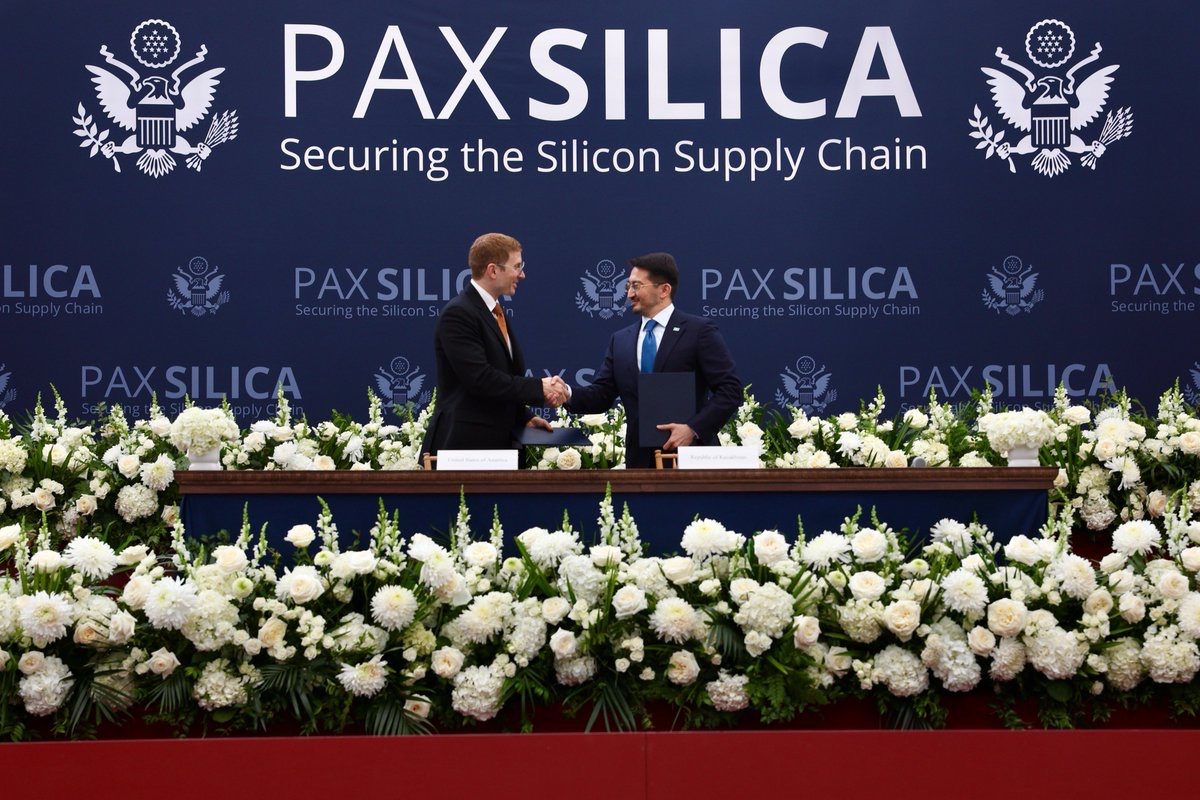
Kazakh state media quoted Helberg praising the country's minerals, its place on the trade route across the Caspian, and its economic reforms. He announced a "Foundry School" with Stanford to train engineers across the member countries. He also said the US and Kazakhstan would set up an "economic security zone" for minerals in Central Asia, which remains to be explained.
Three weeks later, on 16 July, twenty-nine countries signed the founding agreement for the World Artificial Intelligence Cooperation Organization on the opening day of the World AI Conference in Shanghai, an intergovernmental body headquartered there. Four of the five Central Asian states are founding members: Kazakhstan, Uzbekistan, Kyrgyzstan and Tajikistan. Kazakhstan's Deputy Prime Minister and Minister of AI, Zhaslan Madiyev, signed this one too.
The Diplomat, 21 July 2026 · thediplomat.com · TV BRICS, citing the Chinese foreign ministry and Indonesia's communications ministry · tvbrics.com · The Star, citing Bernama · thestar.com.myFlags show a selection of members, not full rosters. Neither initiative publishes a live list and counts move; figures are pinned to the dates given. That Kazakhstan is the only state in both is my own inference from comparing the two membership lists — no source states it.
The Diplomat's take is that WAICO's founding members were mostly countries already signed up to China's Belt and Road and Digital Silk Road. That describes Central Asia exactly, and it should concern Western planners.
The scale problem
Because under all the bloc-counting sits a simpler fact. China isn't just a big presence in Central Asia any more. It's the biggest.
2025 goods trade with Kazakhstan. China: Chinese Ministry of Commerce data via Euronews. Russia: figures announced at the May 2026 bilateral summit. United Kingdom: Kazakh government figures via Qazinform, not checked against ONS. The three are drawn from different national statistical systems and will not reconcile exactly.
China–Central Asia trade reached $106.3bn in 2025, up 12% and past $100bn for the first time, and China became the region's largest trading partner. Cumulative Chinese investment reached $35.9bn by mid-2025, up 1.5-fold since 2020, making Central Asia second only to Africa as a destination for Chinese capital. The second China–Central Asia summit in Astana in June 2025 produced 58 agreements worth about $25bn and a Treaty of Permanent Good-Neighbourliness.
China's Ministry of Commerce via The Astana Times, 21 January 2026 · astanatimes.com · Eurasian Development Bank via Euronews, 15 April 2026 · euronews.comOne suspicious number
Chinese figures put trade with Kyrgyzstan at $23.6bn in 2025, up from $17.4bn. Kyrgyzstan's whole economy is smaller than that number. When goods pour into a small landlocked country at several times the size of everything it produces, they aren't being used there, and goods slipping round Russia sanctions through this region has been a known problem since 2022.
And then the letter
On 14 August 2026 Reuters reported a State Department draft letter warning signatories of the June AI Opportunity Statement that joining WAICO would mean exclusion from Pax Silica. Per that reporting the letter does not name China, carries no date, and had not been sent.
Relayed by TechTimes · techtimes.com · MLQ News · mlq.aiTwo things worth pulling apart. The first is a technicality that most coverage has missed: the letter went to countries that signed a broader "AI Opportunity Statement", 35 of them, on the State Department's own count, not to the 24 that actually signed Pax Silica.
The second is my own view. The threat is being left out of a club and its co-investment. No fines or technology embargo. Now look at what Kazakhstan brings to that club: rare earths, tungsten, copper, uranium, the very things Pax Silica was set up to secure. A country whose contribution is the raw material has a lot more room to say no than one whose contribution is the chip factory or human capital. If the letter goes out and Kazakhstan shrugs, it's the U.S. that looks weak.
The number that changes everything
All the coverage has been about Kazakhstan, because Kazakhstan is the one in both clubs. But the bigger number is this: China signed up four Central Asian governments in a single afternoon, and the United States has one after months of negotiation. In a region where China is now the largest trading partner and the second-biggest place it sends its money anywhere in the world. Kazakhstan being in both isn't a sign the region is balanced, but a sign that Kazakhstan alone has the leverage to sit on the fence. The letter would ask the one country with options to give them up for uncertain benefits.