The Geography of dependence
Over four days in July, drones hit four tankers at a Russian port, and Kazakhstan started running out of somewhere to put its oil. What happened next explains why a country can criticise its neighbour in public and change almost nothing.
On 19 July 2026, drones hit two tankers at the Russian port of Novorossiysk. Within days, Kazakhstan was having to cut oil production. Officials said it was a technical decision, and in a narrow sense it was: the pipeline had been shut at the sea end, so the tanks at the other end were filling up with nowhere to send it.
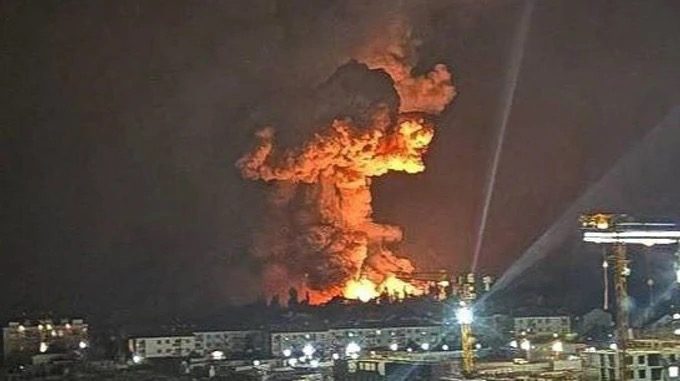
This might seem confusing at first. The oil is Kazakh. The fields are Kazakh. The tanks are Kazakh. But they rely on a Russian port, which is a valid Ukrainian target. Kazakhstan got hurt by a fight it isn't in, because of a decision it never made.
The CPC route carries around 80% of Kazakhstan's oil exports and more than 1% of global crude supply. In 2025 it shipped roughly 70.5 million tonnes, over three-quarters of it belonging to foreign shareholders — Chevron, ExxonMobil, Eni and Shell alongside KazMunayGas.
Euronews, 21 July 2026 · euronews.com · The Moscow Times, 23 July 2026 · themoscowtimes.comThe pipeline is about 1,510 kilometres long. It starts at the Tengiz field, loops north round the Caspian through Atyrau, crosses Russia, and ends on the Black Sea. Kazakhstan owns the oil but not the exit. And July was not the first time that mattered.
The strikes form a sustained campaign rather than isolated incidents, with reported attacks in November 2025, January 2026, April 2026 and repeatedly through July 2026, and a first inland strike on the Kropotkinskaya pumping station traced to February 2025.
The Times of Central Asia, August 2026 · timesca.com — regionally based; this incident-by-incident chronology is not corroborated elsewhere here.The telling detail is who Kazakhstan complained to. After the November strike, the foreign ministry called it a deliberate attack on civilian infrastructure and said it had damaged relations with Ukraine. Kyiv said it was only hitting back at Russia. So Kazakhstan blamed the side firing the drones, not the side whose war put its economic lifeline in the line of fire.
The other route
Ask anyone in Brussels, London or Washington what to do, and you get the same answer: the Middle Corridor. It runs 4,000 kilometres from the Chinese border at Khorgos, across southern Kazakhstan to the port of Aktau, over the Caspian to Baku, then through Georgia to the Black Sea or on through Türkiye. It never touches Russia.
And it has grown. Before the invasion it moved about half a million tonnes a year. In 2022 that passed 1.5 million. By 2024 it was 4.1 million, six times more in five years. A container from China to Europe used to take 38 to 53 days. Now it takes 18 to 23 days.
This brings us to 2025.
Middle Corridor tonnage: Carnegie Endowment and The Times of Central Asia, citing TITR figures. CPC volume: Euronews, 2025. The two move different cargoes and are not substitutes commodity-for-commodity; the comparison is of scale, not of interchangeability.
Container traffic on the corridor grew 36% in 2025 to around 77,000 TEU, but total freight volume slipped to about 4.12 million tonnes from 4.48 million in 2024. The combined capacity of the Aktau and Kuryk ports is around 22 million tonnes a year, so the ceiling is not the ports.
TITR leadership interview, The Times of Central Asia, August 2026 · timesca.comThat's the number the corridor's proponents leave out. Containers went up a lot. Total tonnage went flat, then slightly down. And it isn't because the ports are full; Aktau and Kuryk are using less than a fifth of what they can handle. The problem is that a train has to clear ports, railways and borders in five or six different countries without getting stuck, and every one of them is a place where it can.
Some of it is getting better. The Baku–Tbilisi–Kars railway came back into full service on 2 June 2026 after a rebuild, taking its capacity from one million tonnes a year to five, with a plan for seventeen million by 2034. Georgia's main line from Tbilisi to the coast went from 27 million tonnes to 48. Kazakhstan's railway has ordered 300 locomotives from Wabtec for $4.2bn, and more.
Worth noticing who is selling
The two biggest recent orders for trains on the corridor went to an American company and a French one. When British ministers call the Middle Corridor a strategic interest, this is what that interest looks like for everyone else: contracts, financed and delivered. Britain has an export credit agency and nothing to show for it on this route.
But the hard problems aren't going away. Georgia is still the only way through to Europe until a route through southern Armenia opens, and Georgia's ports are close to full — yet the government cut funding for the new port at Anaklia from 150 million lari to 50 million for 2026 (£42m to £14m). Tariffs haven't moved in five years. Operators are offering 30% to 50% off on the return leg to fill empty trains, which is what happens when far more moves one way than the other.
Carnegie's assessment is that obstructive governance, persistent infrastructure gaps, climate change and geopolitical risk may impose a time horizon on the corridor's viability — and that for Central Asian states it offers not a permanent pathway to European markets but a window of opportunity to be used while it is open.
Carnegie Endowment for International Peace, April 2026 · carnegieendowment.orgThe European money is real but hard to pin down. The Samarkand summit in April 2025 announced a €12bn package: €3bn of it for transport, €2.5bn for critical raw materials, with the goal of getting goods to Europe in fifteen days.
However
The Caspian Policy Center has pointed out that nobody knows how much of that is new money and how much is old commitments with a new label. What gets announced and what gets spent are two different numbers, and the gap between them is where most of the writing about this corridor goes wrong. One analysis puts current non-CPC capacity at around 18% of Kazakh production.
What Kazakhstan can actually do
Put the two routes next to each other and the politics writes itself. About 70 million tonnes a year go through Russia. About four million go the other way, and that number didn't grow last year. Kazakhstan isn't one decision away from getting out from under Russia. It's a decade of building away.
Which makes what happened at Omsk on 25 July more interesting.
Sitting beside Putin at the Forum of Interregional Cooperation, Tokayev called for the war in Ukraine to be frozen and urged a return to a revised Istanbul framework. The Kremlin dismissed the proposal within days. IRIS notes that he wrapped it in deference — praising Putin's diplomatic flexibility, offering the view humbly — and reads it as part of a sequence rather than a break: rejecting Russia's annexations in 2022, asking Putin to stop the war in 2026.
IRIS, 29 July 2026 · iris-france.org · Kyiv Independent · kyivindependent.comThe Christian Science Monitor sees this as part of something bigger: the former Soviet states of Central Asia feeling able to push back at Moscow over Ukraine in ways they wouldn't have a few years ago. Now look at what was signed in the same few months.
What is pulling Astana away
- Omsk, 25 July 2026. A public call, beside Putin, for the war to be frozen. Dismissed within days.
- Export vulnerability. Repeated strikes on the CPC forcing output cuts and exposing the cost of a single Russian-transiting artery.
- Rhetoric from Moscow. Mid-level Russian politicians and public figures openly pushing propagandistic narratives about Kazakhstan and attacking its language policy.
- Alliance strain. The CSTO reported in May 2026 to be under pressure, with Armenia absent from preparatory meetings ahead of a November summit in Moscow.
- A pattern, not an incident. The 2022 refusal to recognise the annexations, and now this.
What still holds it in place
- $29bn in bilateral trade in 2025 — a record, set in the same year as the Omsk intervention.
- Balkhash. A 2026 summit agreed two nuclear units financed by Russian state export credit, plus a currency swap. Fifteen documents in total.
- 7,644 km of shared border, the longest continuous international border in the world.
- Institutional lock-in. EAEU membership, labour migration, and transport infrastructure inherited from a state that no longer exists.
- No alternative guarantor. Nothing on offer from the West replaces what the CSTO nominally provides.
Sources across both columns: IRIS, 29 July 2026; The Moscow Times, 5 August 2026; SpecialEurasia, 30 May 2026; Forbes, 10 May 2026; Christian Science Monitor, 13 August 2026.
Both columns are true at the same time, and most people writing about this pick one. If you think Russia is losing Central Asia, you have to explain the record trade and the nuclear deal. If you think nothing has changed, you have to explain the Kazakh president telling Putin to stop the war to his face in public.
I cannot adjudicate between them from open sources. Analysts writing from a Russian vantage point argue that trade volumes, EAEU membership and dependence on Russian grain and transport mean Moscow's position is being renegotiated rather than lost; Atlanticist institutions read the same facts as alienation. Both have institutional viewpoints and neither is neutral.
Compare CEPA · cepa.org with Geopolitical Monitor · geopoliticalmonitor.comMy own view is that the two columns don't contradict each other. Being this dependent is exactly what produces this kind of defiance: words, not actions; deniable; aimed at an audience beyond Moscow; and never followed by anything substantive. Kazakhstan is behaving like a country that understands its position in this regard.
Which leaves the question for the next post. If Kazakhstan can't change where it sits on the map, what is it doing with the attention it's getting, and what are the people courting it actually putting on the table?