The British Case
Britain cannot outspend Brussels, Beijing or the Gulf in Central Asia. That is the beginning of the argument for engagement rather than the end of it, but only if the offer is built around what Britain actually has.
The usual case for the West bothering with Central Asia goes like this: they have the minerals, they have the trade routes, and we need both. That's true. It's also the weakest argument available, because the obvious reply is that China has more of the region's trade, more of its investment, and a ten-year head start.
The better argument starts with a gap. These are countries with more resources than they make use of, more people than they can employ, and a set of problems that come from policy rather than geography. The question for a mid-sized country like Britain is whether it has anything that helps close that gap. It does — just not the things it usually leads with.
A young region in an ageing world
Central Asia's population has grown from 17.5 million in 1950 to over 80 million, and is projected to pass 114 million by 2050. Nearly a third is under 15, well above the global average. Median ages in 2025 run from 22.2 in Tajikistan to 29.7 in Kazakhstan; in the three youngest states the median will still be under 30 in 2050.
UNFPA Eastern Europe and Central Asia · eeca.unfpa.org · UNICEF, Generation 2050 in Central Asia, 7 November 2025 · unicef.orgA young population is only an advantage if there are schools and jobs to match it. Right now there aren't enough of either. Graduates come out with qualifications that don't fit the work on offer (sound familiar), and a steady stream of them leave for Moscow or further. That's the hinge of the whole British argument, and I'll come back to it.
The growth numbers, meanwhile, put the West to shame. The region grew 6.2% in 2025 on the World Bank's count and 6.6% on the Eurasian Development Bank's. The US is forecast at about 1.6% for 2026 and the euro area at 1.1%.
And the convergence arithmetic is sobering. On current trajectories the World Bank estimates it would take Kazakhstan and Turkmenistan around 40 years, Kyrgyzstan 70, and Uzbekistan and Tajikistan over a century to reach the high-income threshold of $14,005 per capita, even while investment runs at about 26% of GDP, one of the highest ratios among developing regions.
World Bank analysis via The Times of Central Asia · timesca.com — reported at second hand; the underlying publication should be consulted before citation. Growth figures: Euronews, 6 February 2026 · euronews.comRead those two facts together. Money is going in faster than almost anywhere in the developing world, and it isn't making these countries rich. That's not a shortage of cash. It's a shortage of the things that make cash productive: working institutions, skills, and access to markets.
The problem they've made for themselves
Trade costs in the region average 1.4 times those of coastal developing economies. But the more striking figure is internal: between 2017 and 2022 Uzbekistan sent about 15% of its exports to its own neighbours and Kazakhstan about 8%. These economies are more connected to external partners than to each other, held back by overlapping regulations, fragmented standards and weak market linkages.
UNDP · undp.orgBeing landlocked costs you. Being landlocked and refusing to trade with your neighbours costs you twice, and that second part is a choice. It's also the one place an outsider can genuinely help without asking anyone to pick a side: shared standards, customs that talk to each other, qualifications recognised across borders. Dull, technical, but cheap for what it does.
Where the money actually is
The minerals argument needs the same treatment, because people keep making it about the wrong part.
In April 2025, on the eve of the EU–Central Asia summit, Kazakhstan announced the Zhana Kazakhstan find in Karagandy region: 935,400 tonnes of estimated rare earth oxides across four prospective zones, with total ore potential put at up to 20 million tonnes at 300 metres depth and an average content of 700 grams per tonne. If confirmed, Kazakhstan would rank third globally behind China and Brazil.
Reuters, 2 April 2025 · reporting syndicated via Al Arabiya · Euronews · euronews.comThis comes with some big limitations
The site requires significant examination before any real investment will arrive, the head of Kazakhstan's own association of mining experts told Euronews more digging was needed before anyone could call it a deposit. Furthermore, the site is 80 kilometres from the nearest railway. And a Carnegie analyst told The National in August 2026, in so many words, that Kazakhstan is not going to replace China any time soon. The timing of the announcement — the day before a summit with the EU is also quite convenient.
But the size of the deposit isn't really the point, and this is where most Western thinking about minerals goes wrong. China doesn't dominate rare earths because it has the most rock. It dominates because it does the refining, around 85% of the world's processing. A mine in Kazakhstan that sends its ore to China to be processed does nothing at all for Western independence.
Illustrative, not to scale. Processing share: rare-earth industry analysis, May 2026. SARECO capacity: the Kazatomprom–Sumitomo joint venture at Stepnogorsk, nameplate 1,500 tonnes of rare earth oxides a year, recovered from uranium-ore residue.
Kazakhstan's entire refining capacity for rare earths is one joint venture, between the state uranium company and Japan's Sumitomo, rated at 1,500 tonnes a year. Which tells us two things: how far there is to go, and where a western partner could actually make a difference, not by finding more ore, but by paying for the step that turns ore into something you can sell.
The same goes for everything else the region has. Kazakhstan mined about 25,839 tonnes of uranium in 2025, roughly 40% of the world's supply, and has been deliberately moving up the chain; it opened a fuel pellet plant in 2021 that hit its full 200-tonne design capacity in 2024. Turkmenistan has the fourth-largest gas reserves on earth and can't get most of it to a market that pays. Tajikistan and Kyrgyzstan have most of the region's hydropower potential, most of it unbuilt. In every case, the problem isn't the resource. It's what happens after you dig it up.
Why any of this is Britain's problem
Four reasons. Only one of them gets talked about.
Refining, not reserves. If the West really is worried about critical minerals, the thing that would change the picture is refining capacity. It's expensive, slow and boring, and it's the only part of the chain where a newcomer actually takes something away from China.
Sanctions. Goods slipping around Russia sanctions through this region are a real problem, and the odd numbers show up in China's own trade data. Cracking down without offering anything in return just breeds resentment. Cracking down alongside real trade and help with financial crime gets you cooperation. Britain already does the second bit: the Treasury talks to Kazakhstan's financial watchdog and has trained Kazakh banks, and it's in Britain's own interest, because dirty money from this region ends up in London.
The window is open now. Kazakhstan being in both technology blocs shows the region hasn't been sewn up yet. Four of five in China's bloc shows how fast that could change.
The market. 114 million people by 2050. Young, moving to cities, getting richer, and with a proven appetite for foreign education and professional services. British firms currently get a rounding error of it.
The lever nobody is pulling
More than 80% of migrants from Tajikistan and Kyrgyzstan and 57% from Uzbekistan go to Russia. Money sent home was 47.9% of Tajikistan's GDP in 2024 and 26.6% of Kyrgyzstan's. That is the deepest dependency in the region, and it's the one Western strategies never mention, because dealing with it means talking about visas, which no Western government wants to do, Britain least of all. This is an impossible problem, no western government is going to willingly replace Russia in this regard, so instead the west will have to provide economic incentives within the countries themselves.
What Britain has actually done
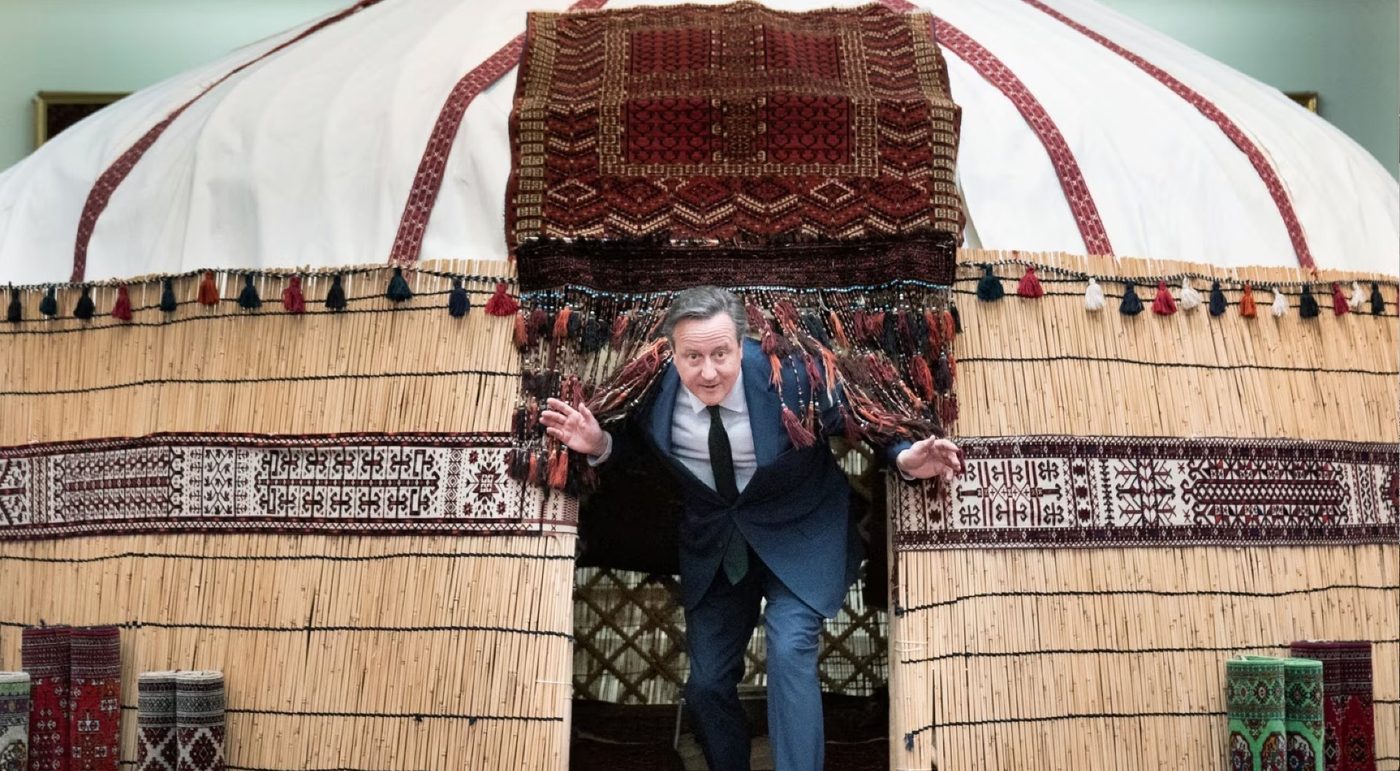
The last two years have changed more than the previous twenty. David Cameron's tour in April 2024 made him the first Foreign Secretary ever to visit Turkmenistan, Tajikistan or Kyrgyzstan, and the first in Uzbekistan since 1997. Then on 26 February 2026 all five foreign ministers sat down with Yvette Cooper at Lancaster House, the first time since independence that the five had met a British foreign secretary together.
The same visit produced a Kazakhstan–UK Roadmap on Strategic Partnership in Critical Minerals through 2027, signed after a business roundtable led by Chris Bryant with BP, Standard Chartered, LSEG, UK Export Finance and Eutelsat OneWeb represented. Its emphasis is on exploration, processing, refining, recovery of associated components and recycling rather than extraction volume. Kazakhstan has since ratified its strategic partnership and cooperation agreement with Britain, covering energy, critical minerals including rare earths, IT, law enforcement and rule-of-law cooperation, and educational exchange.
Trend.az, 26 February 2026 · trend.az · The Times of Central Asia, May 2026 · timesca.comNotice the roadmap already talks about processing and refining. The paperwork points at the right part of the chain. Whether any British money follows the paperwork is a different question, and so far the honest answer is: none has been announced.
What has followed is the stuff Britain is actually good at.
| Instrument | What was announced | Why it is hard to displace |
|---|---|---|
| Higher education | Coventry University licensed campus in Almaty; Heriot-Watt campus in Aktobe; Cardiff University AI centre | Kazakhstan already hosts four branches of British universities; nearly 6,000 students have taken British degrees via Bolashak |
| Schooling | Charterhouse School opening in Almaty | Elite formation with a multi-decade payoff and no obvious Russian or Chinese equivalent |
| Legal architecture | UK assistance with legislation for an International Dispute Resolution Centre at Issyk-Kul, Kyrgyzstan, operating under English law | Follows the Astana International Financial Centre model; once English common law is the default, switching costs are high |
| Capital markets | Uzbek sovereign and corporate bonds worth over $15bn listed in London | Ties sovereign financing to a UK-regulated venue |
| Financial-crime capacity | Treasury partnership with Kazakhstan's Financial Monitoring Authority, following UK training of Kazakh institutions in 2022 | Serves a direct UK interest: illicit finance from the region ends up in London |
Sources: Trend.az and Qazinform, 26 February 2026; Caspian Post, 24 February 2026; Times of Central Asia, May 2026; Foreign Affairs Committee report, December 2023. Trade and investment figures throughout this section are from the Kazakh government.
Keep in mind
An 84% rise from a small number is still a small number. Britain's $1.62bn of trade with Kazakhstan sits next to $29bn for Russia and $39.8bn for China. Britain is still a niche player in the region and has some way to go.
What Britain should do
Start with what the region says it wants, which isn't what the West usually offers. They want to keep more of the value; Uzbekistan’s Mirziyoyev has said outright that the point of the minerals is to build industry, not just export rock. They want contracts that hold up, which is why Kazakhstan's financial centre runs on English law and Kyrgyzstan is copying it. They want more than one way out. And they don’t want to be made to choose sides either.
Against that, the West keeps making four mistakes. Announcing money instead of spending it, which gets noticed. Turning cooperation into a loyalty test, which is what the Pax Silica letter would do. Focusing only on Kazakhstan and Uzbekistan, which leaves three capitals to Moscow and Beijing by default. And mistaking summits for results, the region now has a C5+1 with the Americans, an EU summit, a British ministerial and a German format, and each new one means a bit less than the last.
The chart plots what each option would cost the Treasury against how much influence it could plausibly buy. You can click any point for the reasoning.
Give CA5+UK a spine
A meeting that happens once is a photo. Put the schedule in writing, take turns hosting between London and the region, name one senior official as responsible for it, and publish a short list of what was agreed after each one. The MPs' complaint was that partners read Britain's seriousness from how it behaves. Being predictable is how you show it, and it costs almost nothing.
Cost: minimal, largely existing FCDO resource. Risk: another format that underdelivers.Treat English law as an export
This is Britain's strongest card and the one nobody else can play. Kazakhstan's financial centre and the planned dispute centre in Kyrgyzstan both run on English common law. Make it a standing offer: help designing commercial courts, arbitration, insolvency rules and investment protection, delivered by the Foreign Office, the judiciary and the professional bodies together. Neither Moscow nor Beijing can match it, and once a country's contracts run on your law, they don't switch.
Cost: low. Leverage: high and compounding.Aim education at the three that get ignored
The new campuses in Kazakhstan are welcome, but they follow the money to where Britain is already strong. A scholarship and campus programme aimed on purpose at Kyrgyzstan, Tajikistan and Turkmenistan would cost a fraction of a railway loan and tackle the problem of three countries nobody talks to. It also goes straight at the thing that decides whether all those young people become an asset or a problem — which is the best argument for British involvement and the one nobody makes.
Cost: low to moderate. Payoff measured in decades, which is also the objection.Pay for trains, not studies
What actually holds the Middle Corridor back is physical: ships on the Caspian, cranes at the ports, locomotives, border queues. The two biggest recent orders went to an American firm and a French one. Export finance guarantees for British kit would turn a stated interest into an actual contribution to the bottleneck everyone else just talks about.
Cost: contingent liability rather than cash. Only worth doing if a genuine UK supply base exists.Back the refining, not the mine
Kazakhstan's entire rare earth refining capacity is one Japanese joint venture doing 1,500 tonnes a year, against China's 85% of the world. The UK–Kazakhstan roadmap already names processing and refining. The test is whether British money ever follows the words.
Cost: high, capital-intensive, long payback. Where announcements most often fail to convert.Be the partner that doesn't make you choose
While Washington drafts ultimatums, Britain's most distinctive offer is to be the one that doesn't demand a choice. It costs nothing and it's exactly what the region says it wants. It does carry a cost with the Americans, and that should be weighed honestly rather than waved away.
Cost: nil fiscally, real diplomatically. The trade-off is with Washington, not Astana.Be straight about the politics
These aren't democracies. Pretend they are and events will embarrass you. Demand they become democracies before you'll deal with them and they'll simply say no. The defensible position is narrow: help with courts and anti-corruption, because it's in Britain's interest and it's what reformers inside those countries want — and say that, rather than dressing it up as a mission.
Cost: political, at home. The alternative is a strategy that cannot survive scrutiny.The case against
Britain doesn't have the bandwidth. The Foreign Office is dealing with Ukraine, the Middle East, the Indo-Pacific and a tight budget. A region of 80 million people and $1.6bn of British trade may simply not make the cut, and a strategy that's announced but never funded can be worse than none.
This overpromises. Russia has 7,644 kilometres of border with Kazakhstan. China's trade with the region is sixty times Britain's trade with Kazakhstan. On any realistic view, Western influence stays at the edges. The honest version of this whole project might be that Britain can nudge things and nothing more.
We could be helping the wrong people. Campuses, bond listings and arbitration centres give these governments capability and respectability, and they aren't democratic. Whether that's a trade worth making is a tough political judgement.
None of which changes the basic asymmetry. The things that would matter most here are things Britain already has and mostly gives away without noticing: its law, its universities, its professions, its capital markets. They're cheap, but can have significant impacts on our relationships with these countries, and greatly increase our standing.