Spain: Schengen's Trojan Horse
Madrid spent two years building the largest pull factor in Europe. This week the bill arrived.
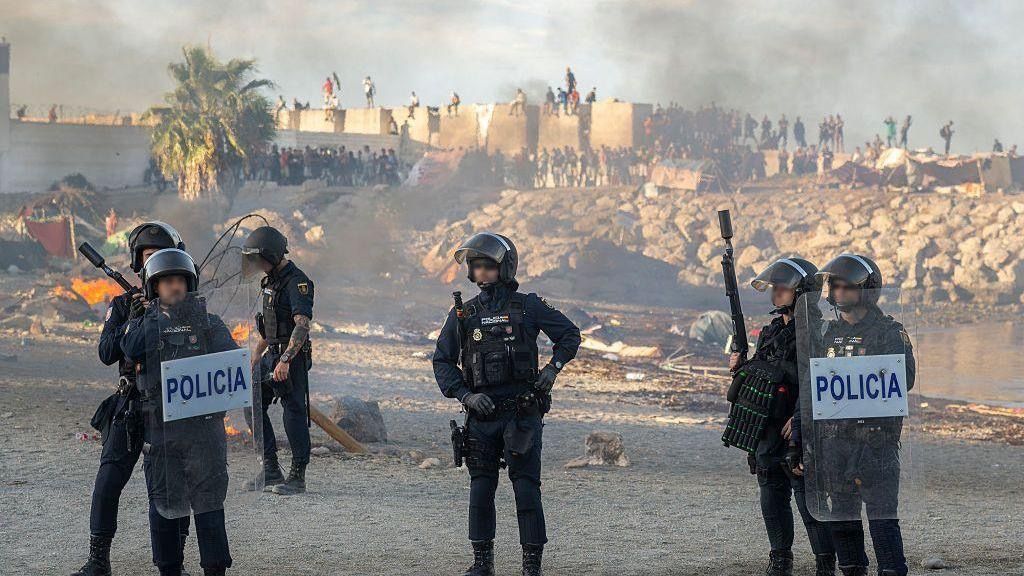
There is a particular sound a political consensus makes when it finally gives way, and Europe heard it this week at a breakwater in North Africa. On Thursday, tens of thousands of people walked and swam around the Tarajal seawall into Ceuta, a Spanish city of fewer than 90,000 souls on the Moroccan coast. Ceuta's president, Juan Jesús Vivas, the Mayor-President of the exclave, put the number at around 60,000 in twenty-four hours. More than two-thirds of the city's population. By Friday the death toll had climbed from 18 to at least 34, as people drowned in the strait, and others were crushed in the scramble at the seawall.
Pedro Sánchez called it "a serious crisis for Spain and for Europe" and blamed the traffickers. This is the reflex of every European government caught without a border: locate the villain offshore, in a smuggler's boat, anywhere but in the cabinet room. It will not wash this time, because the proximate cause of this catastrophe is not a criminal network. It is a judgment of Spain's own Supreme Court, handed down on 29 June, and a government that saw what was coming and did nothing.
That ruling held that Spain's power of summary rejection at the frontier — rechazo en frontera, the "hot returns" that have kept Ceuta and Melilla viable for a decade — applies only to those who climb the physical barriers. Anyone intercepted in the water falls outside it. The message could not have been clearer for prospective illegal migrants: just go around it. For a fortnight there was what a Guardia Civil officer described as a slow trickle, some 1,500 to 2,000 people in ten days. Then, in his words, "an explosion."
A serious state, presented with a court ruling that dismantles its border, legislates. Spain had a month. Spain did nothing, and then rejected Ceuta's request for a formal national emergency on the grounds that migration does not fit the statutory categories, a magnificently Spanish answer, and one that will be quoted for years. Troops went in eventually. Some returns to Morocco were agreed. It is bailing out a hull that is still gushing in water.
- 29 June
The Supreme Court holds that summary rejection at the frontier applies only to those who climb the barriers. Anyone intercepted in the water falls outside it.
- Early July
A slow trickle, in the words of one Guardia Civil officer: some 1,500 to 2,000 people over ten days.
- 30 July
Thousands gather on the Moroccan side and cross on foot and by sea. Spain's interior ministry puts the day's arrivals at around 50,000; Ceuta's president puts it at 60,000.
- 31 July
Italy announces the suspension of Schengen free movement with Spain. France orders checks at the Spanish border stepped up without delay. Ceuta's request for a national emergency has already been refused.
A month passed between the ruling and the surge. Sources: Spanish Supreme Court judgment of 29 June; Spanish interior ministry figures; statements by Juan Jesús Vivas; Italian and French interior ministry announcements of 31 July.
Giorgia Meloni and Antonio Tajani, the Deputy Italian PM, have called for Spain's suspension from Schengen. Legally this isn't possible as no member state can expel another, and they know that. What Italy could do, it did. On Thursday evening Meloni, Tajani and Matteo Salvini announced the temporary suspension of Schengen free movement with Spain, and Rome's interior ministry ordered targeted, selective checks on non-EU travellers arriving from Spanish airports and seaports. Tajani called it a necessary choice, made unavoidable by events. Spain's foreign minister, José Manuel Albares, summoned Italy's ambassador in Madrid and accused Tajani of weaponising migration for domestic advantage.
Madrid's other answer to Rome was to publish the numbers. Citing Frontex figures, Sánchez pointed out that fewer irregular entries have come through Spain than through Italy over the past five years, and by a wide margin.
Frontex figures published by Pedro Sánchez in response to the Italian government, 31 July 2026. On the volume of arrivals Sánchez has a point. It is not, however, an answer to what Spain does with the people once they are inside.
What matters is what France did while this was happening. Laurent Nuñez, the interior minister, ordered controls at the Spanish frontier stepped up immediately. Not proposed, not tabled for a European Council in the autumn, but ordered and in place overnight. Ursula von der Leyen called the images from Ceuta "unacceptable" and said dangerous crossings must stop.
The lesson is the one Europe keeps refusing to learn. Schengen is not a treaty so much as a standing bet: that every member polices its stretch of the perimeter as though the whole continent depended on it, because it does. Break that bet in one place, and the internal borders come back everywhere, not by grand decision, but by interior ministers quietly signing orders on a Thursday night. France, Italy, Germany, Austria, the Netherlands, Poland and others have already reintroduced internal checks under one justification or another. Ceuta did not begin Schengen's unravelling. It simply made it undeniable.
The policy, arriving all at once
Here is the part Madrid would rather you did not dwell on. Ceuta is not an aberration in Spanish migration policy. It is that policy, arriving all at once instead of quietly over years.
On 1 January this year, Spain passed 10 million foreign-born residents for the first time, 10,004,581, or 20.3 per cent of the population. Spain's population grew by roughly 442,000 over the year, overwhelmingly through immigration. One in five people in Spain was born somewhere else. No mandate was sought for this. No manifesto proposed it. It simply happened, and the political class agreed among themselves that noticing it was vulgar.
Spanish National Statistics Institute figures, 1 January each year. The share rose by more than seven points in eleven years, and by 2.1 points in the last two alone.
Then, on 27 January, Sánchez went further, adopting by royal decree the regularisation of some 500,000 undocumented migrants and asylum seekers. The Council of Ministers approved it on 14 April and it entered into force the following day. It is the seventh such amnesty in forty years, the largest in two decades, and one of the largest ever attempted anywhere in Europe. Even the European Commission balked. Ask what signal that sends to a young man in Casablanca watching it on his phone, and you are told that pull factors are a far-right myth. Ask the Guardia Civil at Tarajal.
The government's defence is that the regularised will hold one-year Spanish permits and cannot legally work elsewhere in the EU until they obtain permanent residence. Read that sentence again and notice everything it does not say. A Spanish residence permit allows travel throughout Schengen for ninety days in any hundred and eighty, and the entire architecture of Schengen is the absence of anyone checking on day ninety-one. More to the point, Spain is the most generous manufacturer of EU passports on the continent. It granted 240,200 citizenships in 2023, 22.9 per cent of the EU total, more than any other member state, and 252,500 in 2024, second only to Germany. Nationals of Latin American countries, the Philippines, Equatorial Guinea, Andorra and Portugal need just two years' residence to naturalise, against ten for everyone else. Those regularised this April become eligible for citizenship in a decade.
What Madrid says
- The regularised hold one-year Spanish permits.
- They cannot legally work elsewhere in the EU until they obtain permanent residence.
- Pull factors are a far-right myth.
- The Ceuta crossings have nothing to do with the regularisation.
What actually follows
- A Spanish permit allows travel throughout Schengen for ninety days in any hundred and eighty.
- Nobody checks on day ninety-one. That absence is the whole architecture.
- Spain granted 240,200 citizenships in 2023 — 22.9 per cent of the EU total.
- Ibero-Americans, Filipinos, Equatoguineans, Andorrans and Portuguese naturalise after two years, not ten.
Left column: the Spanish government's stated position. Right column: what the same rules permit.
A Spanish passport is not a Spanish document. It is a European one, and it confers the unconditional right to live and work in Munich, Milan, and Mayo. Madrid is not merely admitting people to Spain. It is admitting them to the rest of Europe, on terms it sets alone, and then presenting the bill to countries that were never consulted.
That is the Trojan horse. Not the enclave, not the seawall, not even the ruling, but a member state that has quietly appointed itself Europe's naturalisation office while assuring everyone that internal free movement is sacred and that anyone who mentions the arithmetic is a bigot.
Vox's Santiago Abascal called the events at Ceuta an invasion, and the respectable press spent Friday deploring his language rather than examining his figures. Vox could take twenty per cent at the election next year, and the same commentators will write the same baffled columns about the rise of populism.
Added 2 August
This piece was published on 31 July. Since then the Spanish outlet The Objective has reported that intelligence assessments warning of the coming surge existed before it happened, according to internal sources. The government denies it. If the reporting stands up, the charge against Madrid is not that it failed to see this coming. It is that it did.