How to win the young without losing yourself
On Sunday Sweden's Moderates took thirty per cent of first-time voters and took back their place as the kingdom's second-largest party after four years in government. Meanwhile the Conservatives are on a pitiful eight per cent with the same group. The difference isn't, however, what you would assume.
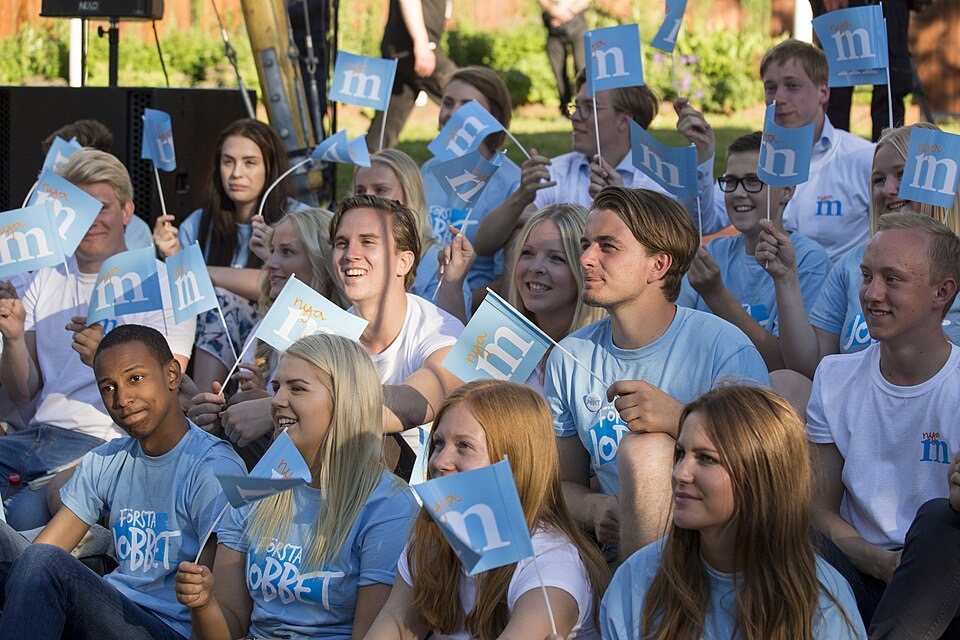
This number should be encouraging for the Tories, but it ought to lead to some self-reflection too. Sweden’s election saw nearly a third of the youngest voters choose the moderates. Not 30% of the total right-wing vote, but 30% outright. Making it by far the largest party among the cohort, above the centre-left Social Democrats at 20%, and the populist-right Sweden Democrats at just 15% (according to the Swedish national broadcaster and Verian). The national school poll saw similar results, with 33% of under-18s voting Moderate, well clear of any opposition.
Vote share among 18–21 year olds, from SVT’s exit poll. Shares are rounded and sum to 98 per cent; the pie is scaled to the reported figures. Graphic after SVT Datajournalistik.
The equivalent figure for British youth is around 8% and as low as 5%, compared with the Greens at a terrifying 37%. Reform is at roughly double this. And with Kemi Badenoch’s latest ratings showing her worst performance being among under-35s, how can the Conservatives hope to maintain themselves as a political movement?
Two centre-right parties. Both with recent records in government. One dominating the youth vote, the other is in the margin of error of oblivion. The obvious explanations for why this happened aren’t sufficient, so what can the Conservatives learn from Ulf Kristersson’s Moderates?
The recent events in Sweden are incomprehensible to the British politico. The Moderates have governed for the last four years, propped up by the often-extremist Sweden Democrats, through a painful cost-of-living squeeze and a gang-violence crisis that has seen violence rampant through Sweden’s cities. By any British assumption, they should have been slaughtered at the polls, with Kristersson leading his party to a Sunak-esque rump. Instead, their vote share actually went up by a point, and they gained 2 seats. While the right-wing bloc appears to have lost, with the left bloc ahead at 176 seats to the right’s 173 at time of writing, the moderates are the only party of the three largest, to have come out of the election larger than they went in.
The party that got hammered on Sunday was actually their populist partner, who fell from 20.5 to 17.5, losing eleven seats and dropping to third place. Among first-time voters, they dropped 7 points, with the Moderates picking up four.
So while the young as a whole did not swing right, they didn’t swing left either. Instead, young right-wing Swedes stopped voting for the insurgent, in favour of the governing party. This is one of the most interesting electoral anomalies in Europe at this moment, and CCHQ should be studying what happened here, rather than putting out more TikTok memes comparing Andy Burnham to David Brent.
So why did this happen? And it doesn’t have anything to do with social media.
The first is that Ulf Kristersson did something the Tories have refused to do: he defended his record. He campaigned, with a certain brass neck, on the slogan of making Sweden great again (MSGA, not quite the same ring). He pointed to the numbers: annual migration down from 117,000 in 2016 to 12,000 last year, consistently falling crime, and a tougher legal regime. Whatever one thinks of his policies, young Swedes could look to a man who did what he said he would and is asking for four years to finish this.
Contrast the Tories’ approach. Since 2024, the party has behaved as though the last 14 years happened to someone else. They apologise constantly for the immigration (without mentioning the success of Sunak’s reforms), they reach out for the phrase “we got things wrong” so frequently that it only reinforces the perception of their government, instead of owning the many successes in the economic recovery, education or crime. The prevailing narrative has been that, to regain trust, you must show humility by saying this over and over again. In fact, this is an admission that you can’t be trusted with power while simultaneously asking for it back.
The second lesson is one a lot of politicians will find hardest, because it involves a lot of patience. The Sweden Democrats spent the last four years dictating government policy while not taking up any seats in cabinet. They wrote much of the government’s migration agenda and were functionally in power. And, despite the success of the migration policy, the voters punished them for it because they sought power without any responsibility, a perception exposed by Kristersson when he offered them cabinet seats.
There is a comparison here to Reform. Nigel Farage holds the best position in British politics: all the attention, none of the accountability. But that position is not stable, and certainly not one to take him into Downing Street. Once someone can point to something Reform has done rather than said, this position decays, and as Reform gains more and more councils, Reform’s record on social care and potholes might just bite them here. The Moderate’s main achievement through this was to still be standing and looking competent, while their partner’s outsider act wore through.
The third lesson is something the Moderates didn’t do. They didn’t become a tribute act to the populist right. Kristersson’s party remains what it has always been, a liberal-conservative, pro-market, pro-West, party of government. It recovered second place without adopting the vocabulary or style of the party that overtook it in 2022. A lot of Tories’ instincts since 2024 have been to emulate Reform: that in order to win back a defector, you have to agree with them. That doesn’t work. Why choose an imitation with a complicated record when you can have the real thing with a clean slate? The Moderates won these voters back by being unmistakably themselves, and visibly capable of governing, something the insurgent can’t match.
The fourth is dull but matters most. Look at what Swedes said their main priorities were: health, education, crime, immigration, the economy, and social care. That’s a list of things that happen to people in their daily lives. It’s not a list of grievances against institutions or a culture war about what a woman is. Young Swedes didn’t vote Moderate because the party fought these battles online; thirty per cent voted for them because they were presented with a clear plan for how their lives would improve under a Moderate government and a record boasted, rather than hidden from.
There are a few caveats here. Sweden’s system of proportional representation and a formalised right bloc under the Tidö agreement means that Swedes can vote without worrying about splitting the vote, whereas in Britain Conservative and Reform votes can annihilate each other’s chances of winning a seat. The moderates could afford to let the Sweden Democrats exist, lose their appeal, and return their voters without posing an existential threat at any point. The Conservatives may not be able to afford reform the same time. Furthermore, while the Moderates held on, the right as a whole collapsed with young voters. Among men aged 18-29, the Tidö parties fell from 63% to 43%, the Moderates were only successful in increasing their share of a quickly shrinking cake. This is still an achievement and is far more than the Tories have been able to reach since 2010, though it isn’t exactly a triumph either.
What it is, though, is a demonstration that what British Conservatives have long laughed off as impossible is possible. Many Conservatives still say the young are lost to the left for a generation. That the economic system created by the mainstream parties over the last half-century has forced young people to the fringes, and that the Tories should focus on the same base they’ve focused on for the last decade. Sweden suggests otherwise: a third of young people backed a mainstream conservative party, all while a slicker, angrier alternative was on the ballot paper too.
While the Conservatives have taken more initiative with the young, having relaunched the Young Conservatives and expanded their digital reach, this isn’t quite the right way. Kristersson’s party didn’t win the young with an app or a vice-chairman for youth who might just use his position to get hammered at party conference. The moderates won them by being a grown-up option in a crowded field that offered them what they needed without pandering, and refused to be embarrassed about their record. There is no reason a British party can’t do the same; though, at present, there is little sign anyone is trying.